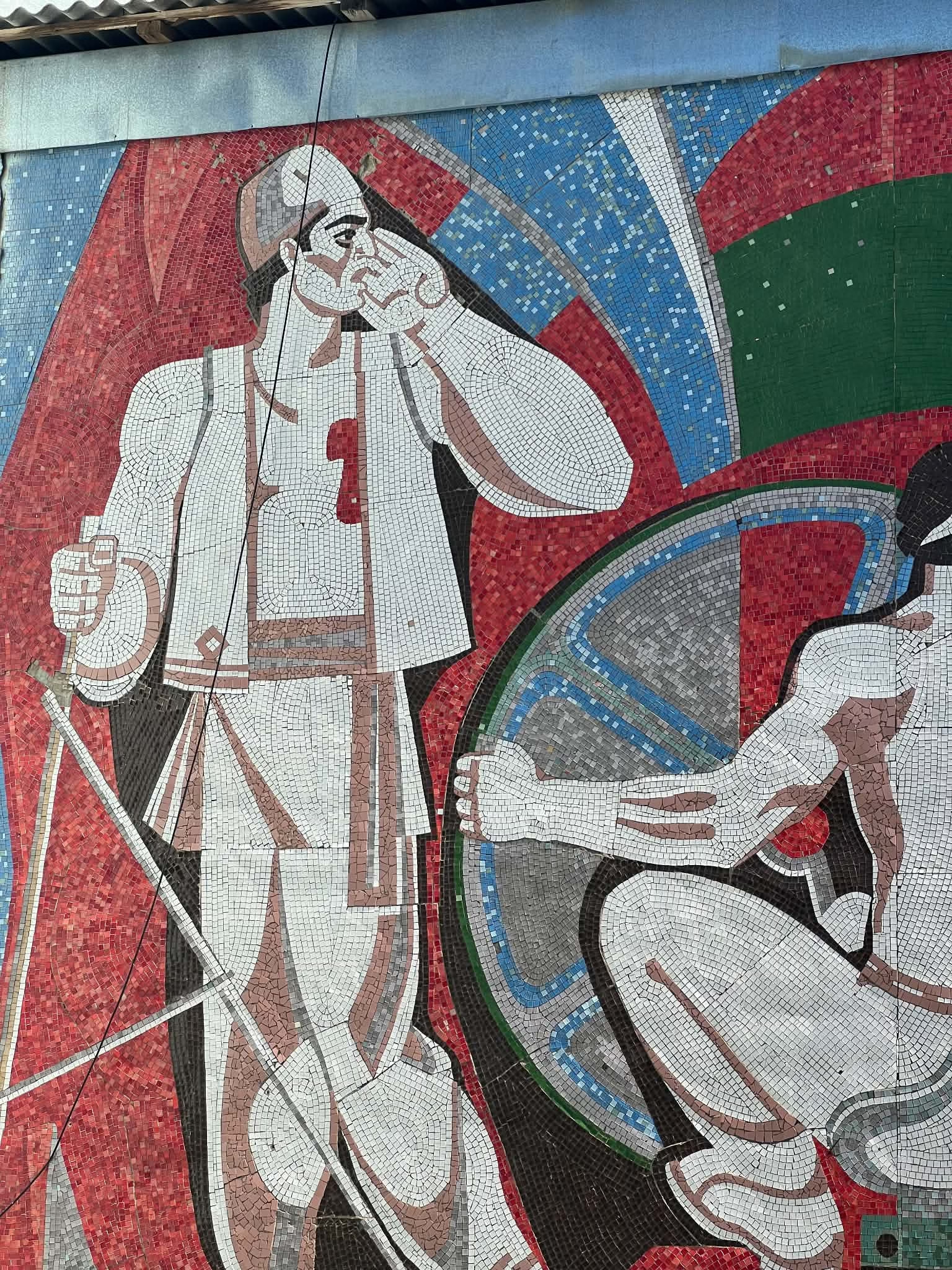
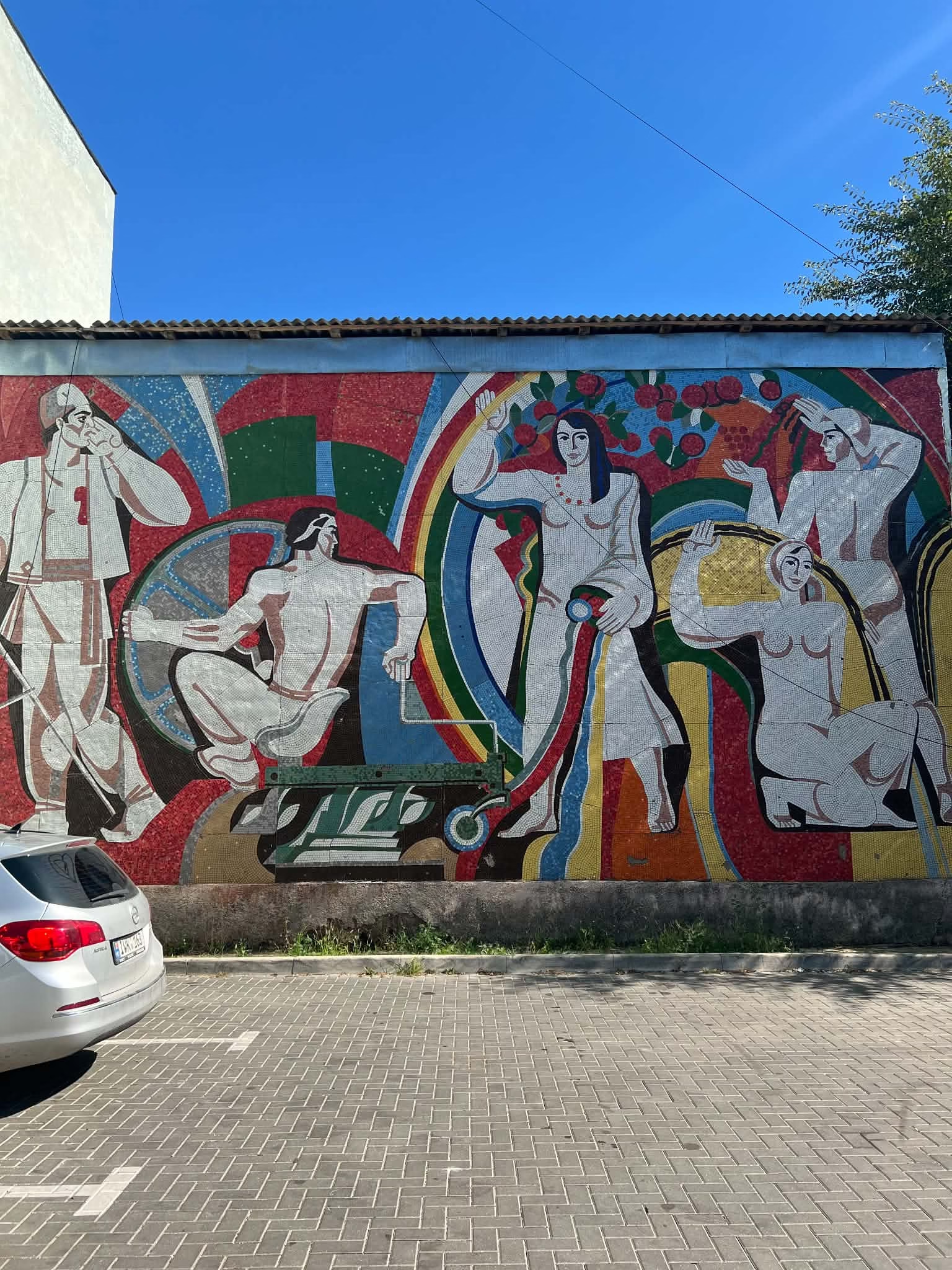
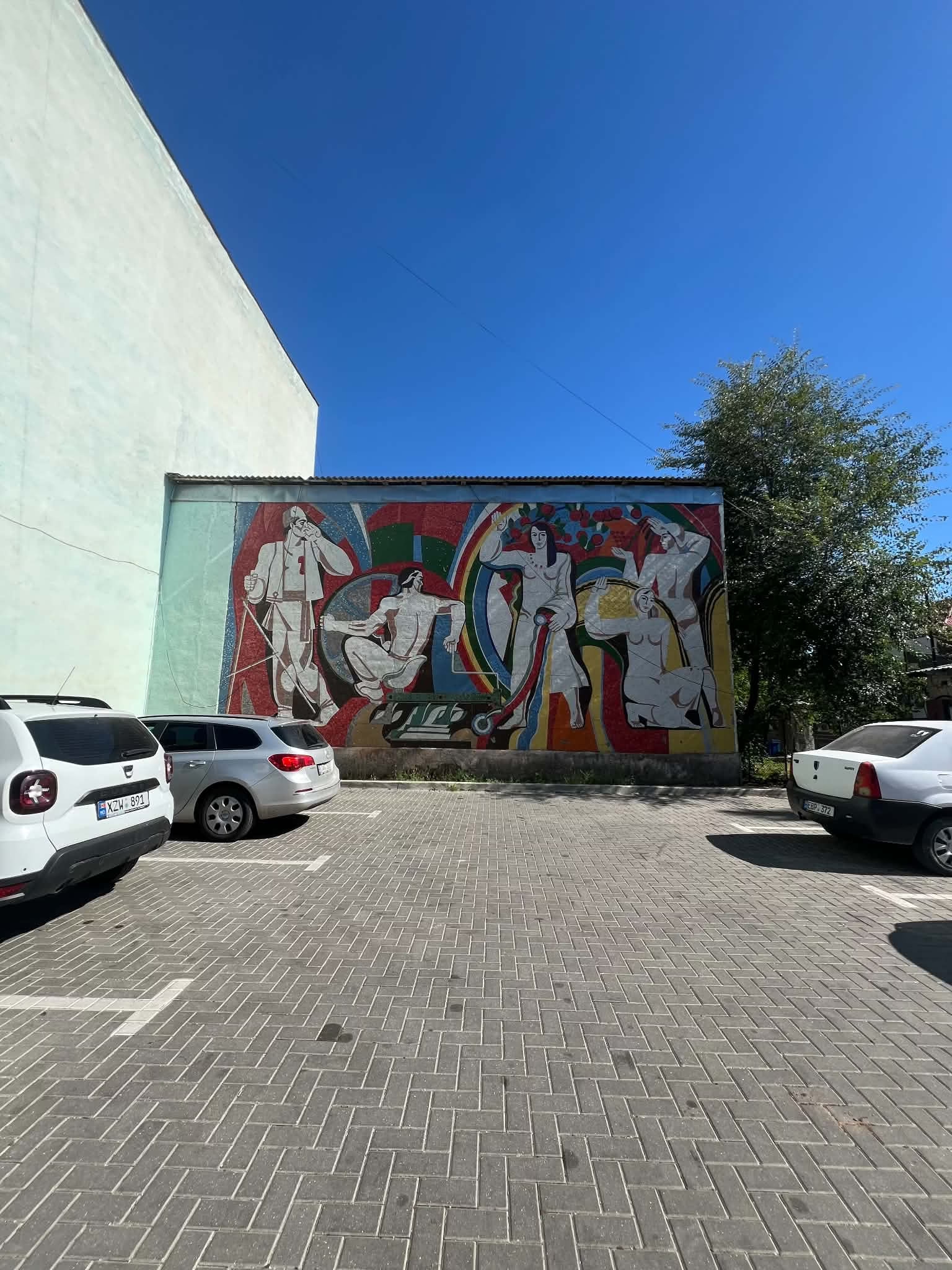
On a police station wall in Ungheni, a mosaic in red, white and green tiles shows a standing figure in white and a crouching figure beside a large wheel. We could not find a source for who made this particular mosaic. But we can tell you who made similar ones across Moldova.
The artists
The Kathmandu and Beyond survey of Soviet mosaics lists several Moldovan artists. Gheorghii Hadjioglov made the mosaics on a sports school (1989) and on the Palace of Culture (1986) in Cahul. Mikhail Burya made „The City is flourishing and being built” (1974) at the Central Bus Station in Chișinău and, with Vladislav Obukh, a mosaic at the Linella Express building in Chișinău (1968). Alexander Kuzmin made „Taming the Fire” (1988) in Chișinău.
How a mosaic was approved
According to the same survey, only artists in the Artists’ Union of the USSR were commissioned by the state, and each design had to be approved by a committee before work started. The mosaics were made of very small pieces of glass or ceramic.
What they show
Typical themes were workers, engineers, scientists, soldiers and astronauts. In the Moldovan city of Bălți, one mosaic shows rows of figures from Lenin at the top down to a woman with a laboratory flask, and an apartment block there is decorated with a Young Pioneer and a woman in folk dress sending a stork with grapes.
Still standing, for now
The survey notes that most of these mosaics have been ignored and left to the elements, and some were removed or damaged. Others survive in excellent shape. Often it is luck, or the shelter of a tree, that decides which.
Do you know a mosaic in your town? Share its location in the comments so we can map them.
Sources: Kathmandu and Beyond, „Mosaics of the former USSR”; Michael Harrison, „Soviet Mosaics – Bălți – Moldova”; The Black Sea, „Glorifying myth and industry in bizarre Soviet mosaics on tower blocks in Balti, Moldova”.