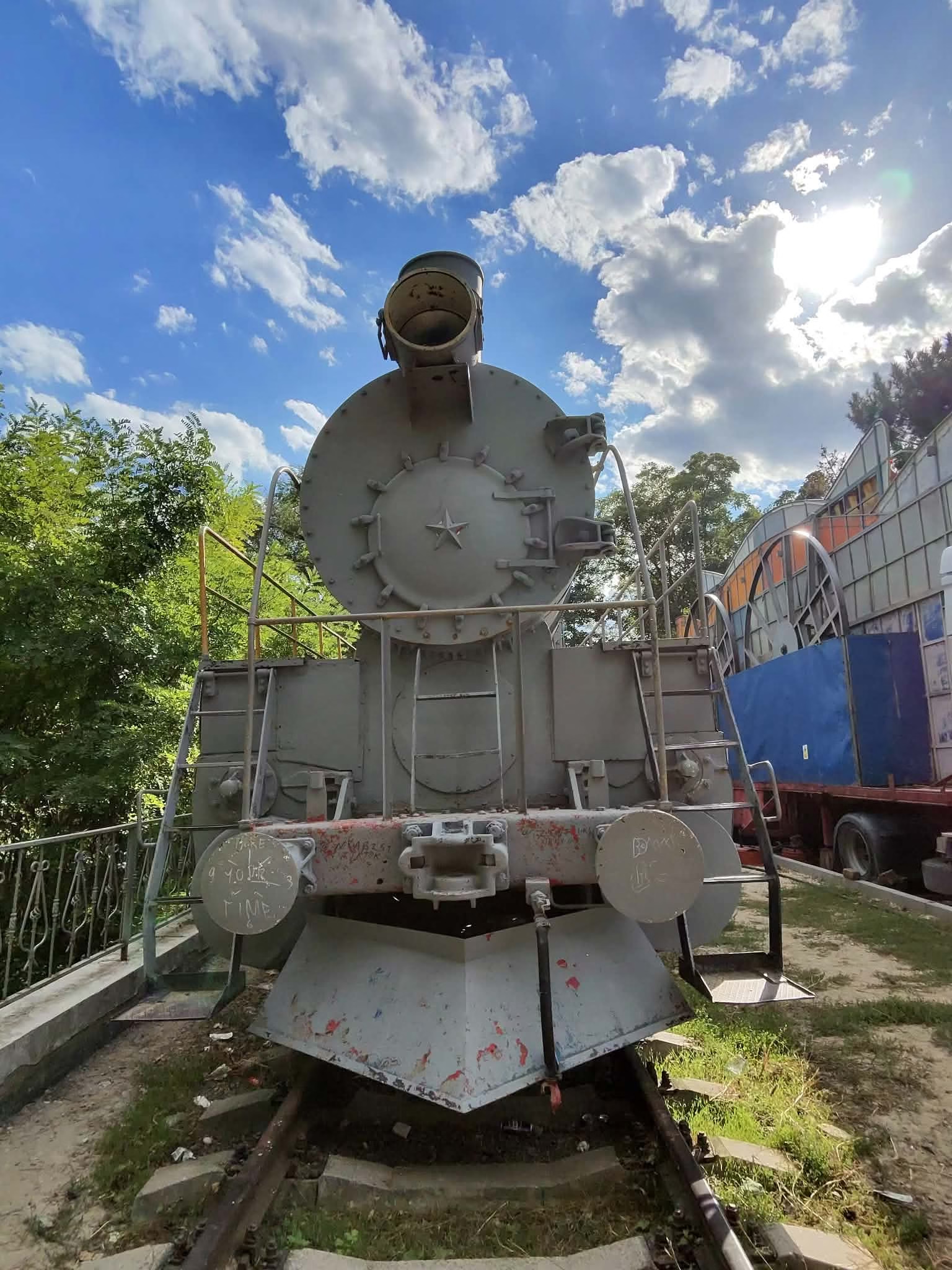
A steam locomotive stands on a short piece of track at Ungheni, Moldova, a railway town on the Prut river on the border with Romania. It is a good symbol for a place whose story has always been about trains.

The railway arrives
According to Wikipedia, the Iași–Ungheni railway opened on 1 August 1874, and the Chișinău–Ungheni line, built between 1871 and 1875, opened on 1 June 1875. The Ungheni tourism website says the old station building was built by the Russians in 1874–1875, and that after the Second World War the Soviets changed its design, giving it a Stalinist Empire style.
The bridge over the Prut
The railway crosses the Prut on the Ungheni rail bridge, also called the Eiffel Bridge. Wikipedia says that it was built in 1874–1876 and credits the engineer Nikolai Belelubsky as designer, although local tradition links the bridge to Gustave Eiffel. That link is disputed. The bridge was blown up in 1941 and rebuilt after the war.
Two gauges, one station
At Ungheni, trains pass from the wide Soviet gauge (1,520 mm) to the standard European gauge (1,435 mm). After the Second World War the route through Ungheni became the main rail link between the USSR and Romania, and the station is still described as the largest railway junction in central Moldova. In 2023 the European Union proposed a new standard-gauge line from Ungheni to Chișinău.
Have you ever crossed the border by train at Ungheni? Tell us about it in the comments.
Sources: Wikipedia, „Ungheni” and „Eiffel Bridge, Ungheni”; Ungheni tourism website, „The old building of the railway station”.