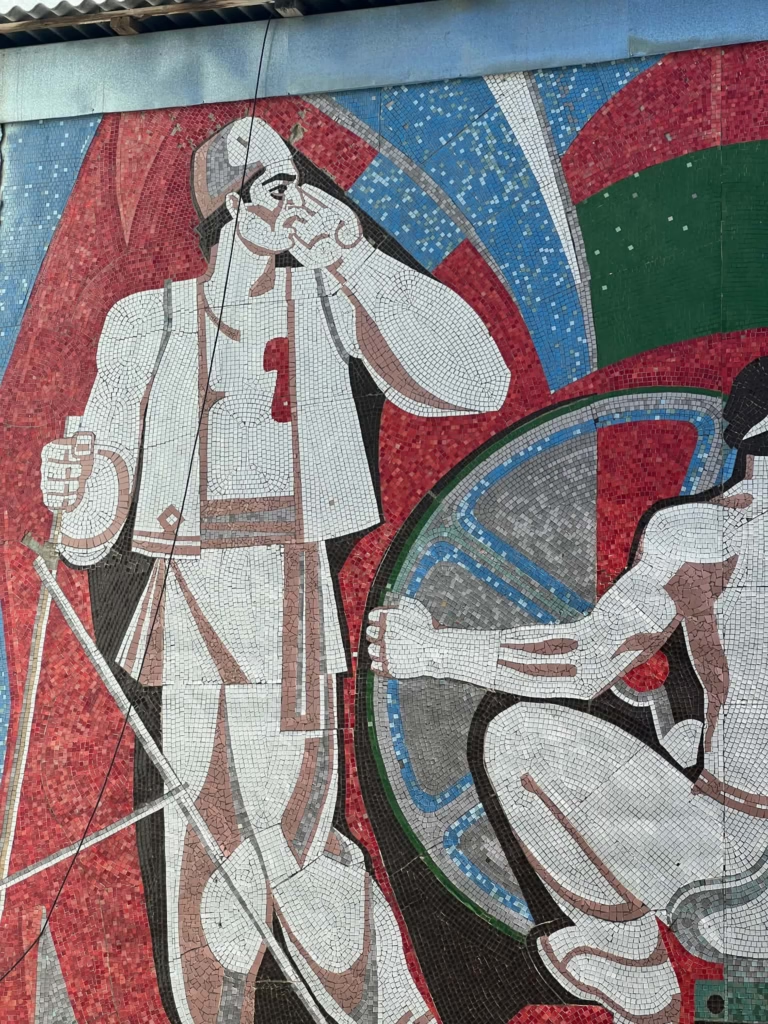
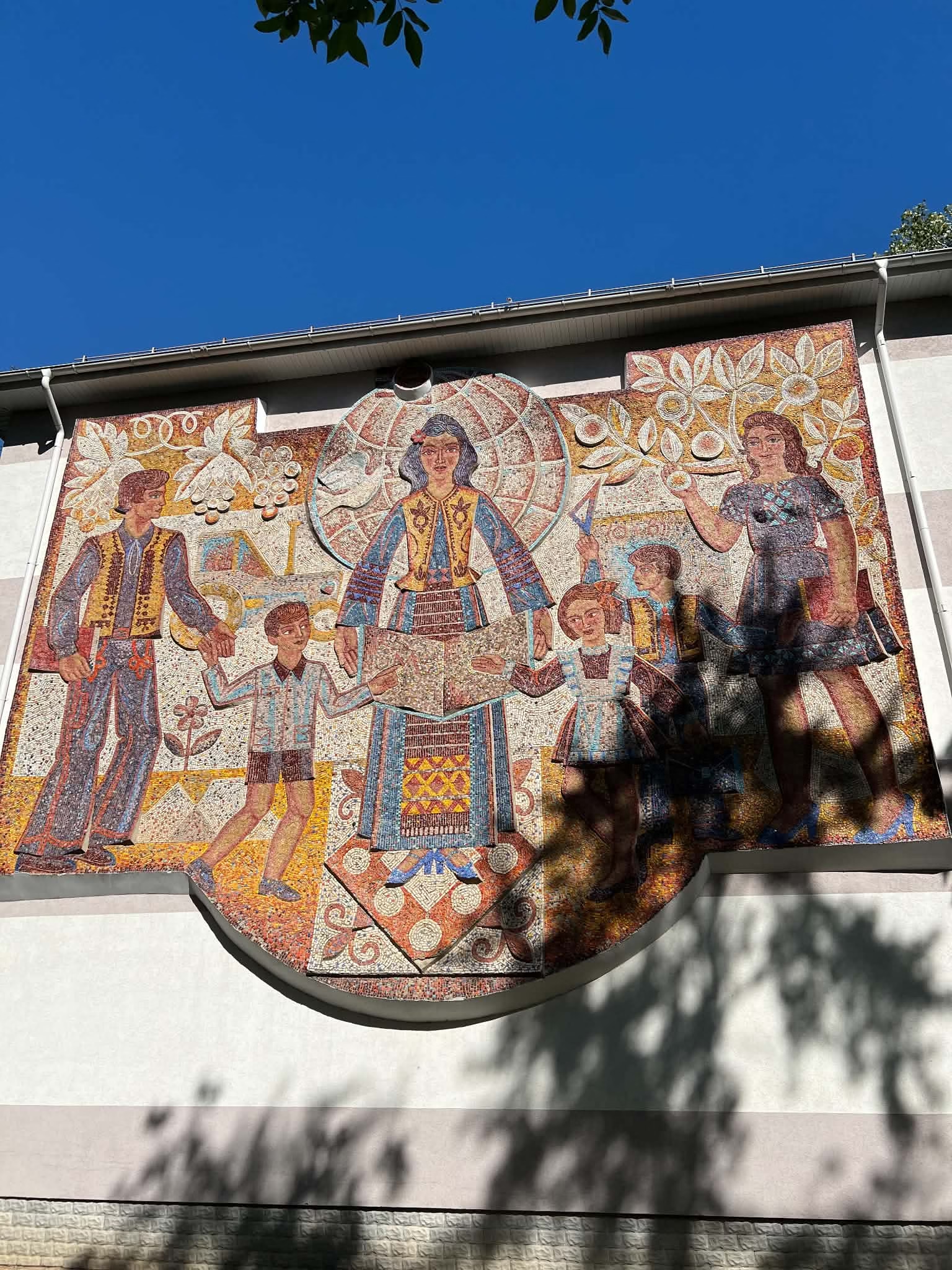
On a school wall in Ungheni, Moldova, a mosaic shows children and adults in folk costume. Public mosaics like this decorated schools, factories, bus stations and apartment blocks across the Soviet Union, and many are still there.
How the tradition worked
According to the Kathmandu and Beyond survey of Soviet mosaics, this kind of public art appeared across the USSR from the 1930s, was stopped under Khrushchev and returned under Brezhnev about a decade later. Only artists in the Artists’ Union of the USSR were commissioned by the state, and each design had to be approved by a committee before work started. The mosaics were made of very small pieces of glass or ceramic.
Themes
Themes included workers, engineers, scientists, astronauts and soldiers, but also children and folk costumes. In Bălți, Michael Harrison describes a primary school mosaic of a girl skipping and children building with blocks.
An uncertain future
New mosaics stopped with the end of the USSR in 1991. Many in Moldova have been left to the elements, and some have been damaged during building repairs. Others, sheltered by trees or by luck, are in surprisingly good condition.
Do you remember a mosaic like this at your school? Tell us in the comments.
Sources: Kathmandu and Beyond, „Mosaics of the former USSR”; Michael Harrison, „Soviet Mosaics – Bălți – Moldova”.